

If you want to understand politics, history, and world events, you could do a lot worse than becoming familiar with Thucydides’ Melian Dialogue.
Thucydides was an ancient Athenian historian and general. The Melian Dialogue is a famous subsection of Thucydides’ history of the clash between Sparta and Athens (History of the Peloponnesian War) which lasted between 431 and 404 BCE. It’s such a classic that it has been quoted by countless authors for over 2,000 years down to this day.
A little background: Melos is an island in the Aegean Sea, about 110 km (almost 70 miles) from the Greek mainland. While Spartan and Athenian armies were busy slaughtering each other in this multi-decade conflict, Melos wished to play the role of Switzerland. They just wanted the big powers to respect their neutrality, and leave them alone. Athens, however, wasn’t keen on allowing them this option. The Athenians were more of the “with us or against us” school of thought, so in 416 BCE they paid a visit to Melos to tell them in blunt terms “either join us and pay tribute or fight us”. The Athenians had already tried to bully the Melians a couple of times in the previous ten years, but this time they took advantage of a truce with Sparta to send a sizeable army to Melos.
In his masterpiece, Thucydides, who wasn’t present during the discussions, offers a dramatized reconstruction of the diplomatic negotiations that followed. It is generally agreed that Thucydides was faithful to the broad outline of the events, but of course the speeches he reports are educated guesses more than faithful transcriptions.
It becomes clear in the course of the dialogue that the Melians are under the illusion they could reason with the Athenians to find a mutually satisfying compromise. But the point that emerges over and over again is that reasoning with bullies is often a tricky undertaking. The Athenians worship one thing and one thing only: raw power. As they explicitly tell the Melians, “The strong do what they can and the weak suffer what they must.” In other words, might is right, and to hell with any moral considerations.
When the Melians appeal to justice and fairness, arguing that a neutral city that poses no threat should not fear for its safety, the Athenians laugh in their faces. The Athenians reply that allowing a small state like Melos to remain neutral is unacceptable since, according to them, other states may interpret it as weakness on the part of the Athenians. Athenian requests—they clarified—are orders to be obeyed, not proposals to be debated. When the Melians argue that attacking Melos would damage Athens’ reputation, the Athenians chillingly counter that the foundations of empire are built on fear, not goodwill. Far from backfiring, brutality on their part will scare other people into submission. The Melians then remind the Athenians that the gods are watching and favor the just, the Athenians shoot them down by saying even the gods only respect power. According to them, morality is a fairy tale in the divine world as much as it is in the human world.
At this point, the Melians switch approach and state their belief that the Spartans will come to their aid to avoid losing credibility in the eyes of the other Greeks. Once more, the Athenians find fault with the Melian logic: after telling them the Spartans would have more to lose than to gain by fighting over Melos, they add it doesn’t matter anyway, since any Spartan help would come too late to make a difference. Running out of arguments, the Melians warn the Athenians that strange things happen in war, and that sometimes weaker states defeat stronger ones. The Athenians chuckle, reminding the Melians that hope is both dangerous and irrational for the weak. Staking one’s survival on the hope of winning the lottery is not a plan. It’s just plain stupid.
With the room for dialogue quickly running out, the Melians make their choice. In a “give me liberty or give me death” kind of moment, they proclaim they’d rather die than give up their freedom and honor by catering to the requests of monsters such as the Athenians. The Athenians tell them submission is their only chance for survival and that, to put it in Star Trek terms, resistance is futile. But if the Melians are dead set about dying, the Athenians will be only too happy to accommodate them.
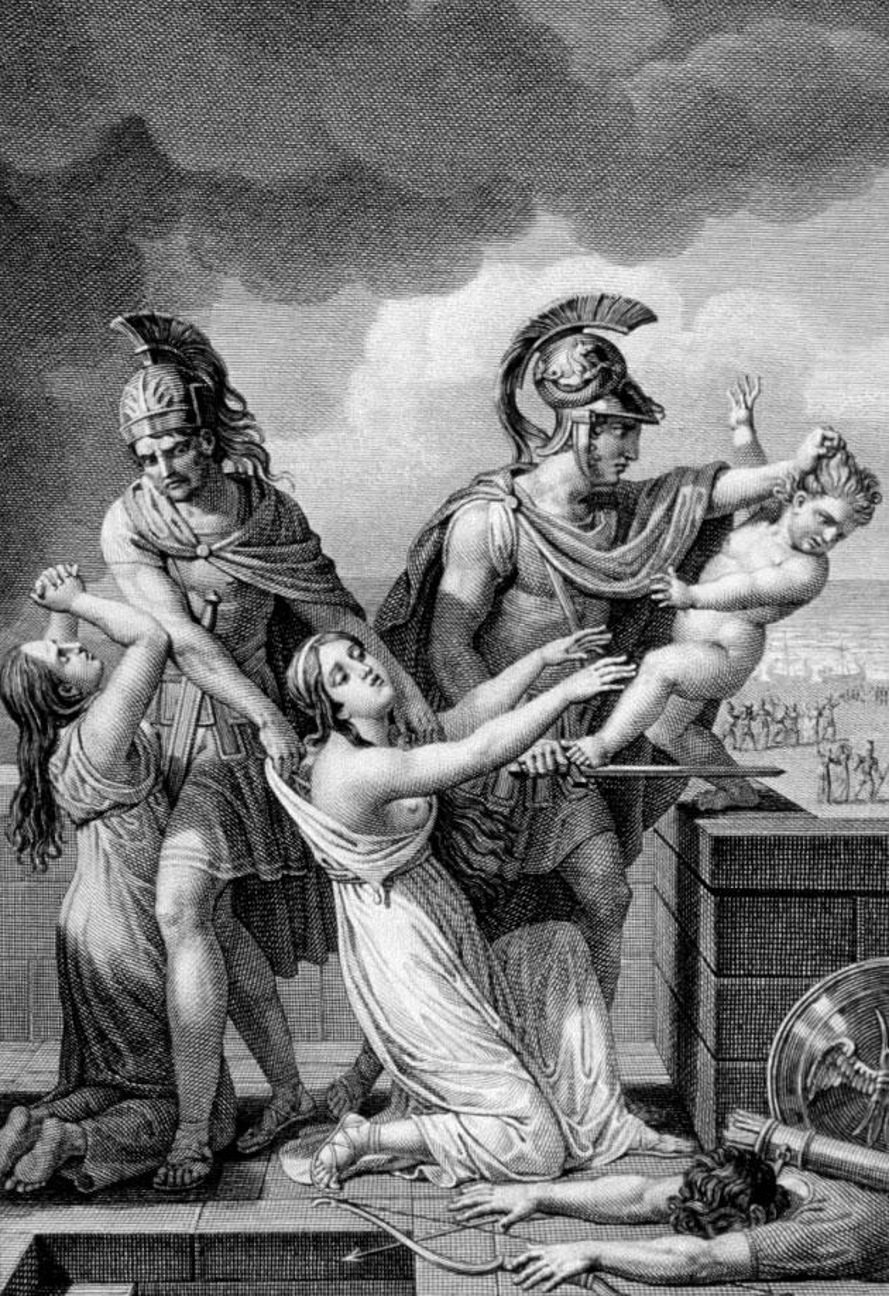
With nothing left to say, a siege followed. Before long, the Athenians breached the Melian walls, killed all the men and enslaved the island’s women and children. Neither the gods nor the Spartans came to Melos’ aid. Being good, reasonable people didn’t help them either. The Athenians then sent their own colonists to take over the now deserted island. Shortly after these events, Euripides, one of the most renowned authors of tragedies in ancient Athens, wrote a work called “The Trojan Women” about the horrible things that happened to Trojan women after the Fall of Troy. Among the main characters: one is raped, one has her throat slit as a sacrifice to Achilles, several are handed out as sex slaves to those who killed their husbands, one sees her baby son being tossed from the walls of the city and killed. The ones who don’t die end up in slavery. Some people believe this was a commentary on what the Athenians had done to Melos. Others think that “The Trojan Women” was staged too soon afterwards so it’s a coincidence. Either way, what happened in Melos was atrocious.
The typical lesson that people have drawn from the Melian Dialogue is that the Athenians were right, that we do indeed live in a universe where fairness and morality are nothing but illusions, and the law of the jungle is the only law that exists. “The strong do what they can and the weak suffer what they must.”
I think this is the wrong interpretation of the dialogue. Or, rather, at best it’s only partially true. It’s a fact that people with powerful armies and zero moral principles can sometimes get what they want. The part most readers forget about the Melian Dialogue is that the Athenians lost the war. The walls were destroyed, the fleet was dismantled, and the empire collapsed. Relying on fear as a source of power only works as long as you are winning. You don’t have friends. You have subjects who will gladly be rid of you the second you begin losing. But one of the rules of history is that no one wins all the time. Plenty of dictators throughout history have discovered that. After ruling with an iron fist, Mussolini ended up shot and his body hung upside down in front of a cheering crowd. Hitler shot himself. Saddam Hussein was hanged. Muammar Gaddafi ended up sodomized with a bayonet before being killed. An endless list of Roman emperors was murdered by their own Praetorian Guard or by their rivals. I could go on. The point being, those who rule by fear meet horrible ends once their enemies feel they have a chance to strike. On the other hand, a system of true alliances and mutually beneficial agreements can protect a country when its military power is not enough. Beloved leaders have a shorter list of people wanting to take a shot at them.
In this light, the real lesson of the Melian Dialogue is how short-sighted the Athenians were. Brutality fosters hatred. Fear only works for so long. Playing fair and fostering good relations isn’t a naïve delusion. It’s not stupid idealism. As it turns out, it’s good strategy.
The podcast you did on this with Darryl Cooper is one of my favorites of all time. One of a few I listened to more than once. All very timely.